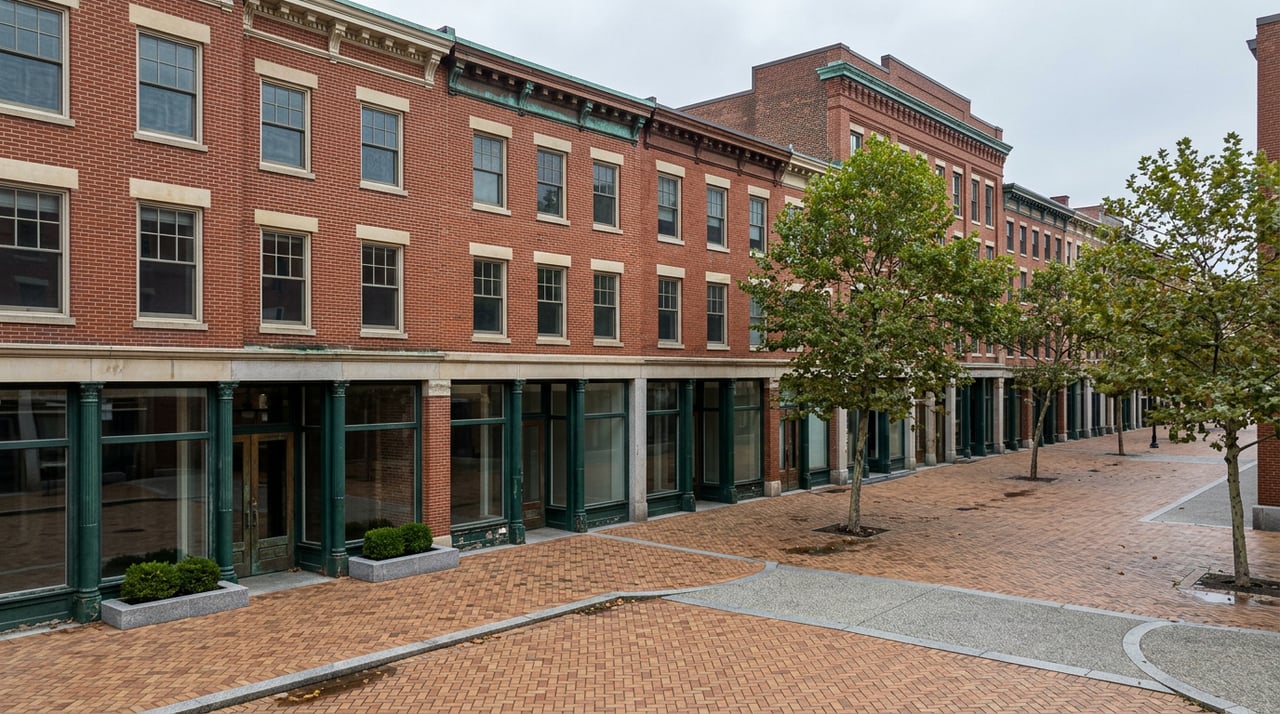
Walk the 200 block of Market Street today and the orange construction fencing that stood there for the better part of two years is gone. So is the loose brick, the temporary plywood walkways, and the detour signage that made getting from the sidewalk to a storefront door feel like an obstacle course. In its place: a curbless plaza at 2nd Street, protected bike lanes, and sightlines that finally let you see all the way down to the river without a chain-link fence in the frame.
The city made this official on June 9, when Mayor Cherelle Parker and a cluster of transportation officials cut the ribbon on the completed Market Street Old City Improvement Project, a $16 million redesign that had been under construction since late 2024. Eleven days later, on June 20, one of Philadelphia's best-known bar owners opened his newest pub two doors down from where the ribbon-cutting happened.
That timing is not a coincidence worth glossing over. It is the story.
The Block That Got Hit Hardest Is the Block That Doubled Down
Job Itzkowitz, executive director of Old City District, has been tracking what happened on Market Street while the fencing stood. By his count, ten new businesses opened or announced plans to open on the corridor during roughly eighteen months of construction. Two of them landed on the same 200 block: Monto, the new Irish pub from Fergus "Fergie" Carey, and Liberty Scoops, a new ice cream shop from the team behind Coffee Tea & Company, a coffee shop a block away that took some of the worst financial damage of the entire project.
Coffee Tea & Company's storefront sat behind fencing that made it hard for walk-in customers to even find the door. The business leaned on a grant from the Merchants Fund, a charitable program for small businesses, just to stay open through the disruption. Most owners in that position spend the recovery period playing defense. Itzkowitz described what this one did instead:
"Not only, in the middle of construction, did they survive that, they said, 'You know what? Let's open another business.'"
That is the detail that separates this stretch of Market Street from a simple before-and-after story. The businesses now anchoring the reopened corridor were not new operators testing an unproven block. They were people who had already absorbed two years of reduced foot traffic and chose to expand anyway, betting that the street underneath the fencing would be worth building on once it came down.
Fergie Carey's Bet Came With Its Own Complications
The 226 Market Street address has carried weight in this neighborhood for a while. It was Mac's Tavern for fifteen years, a bar whose ownership group included South Philadelphia-raised actor Rob McElhenney (credited these days as Rob Mac) and his wife Kaitlin Olson, which made it a minor pilgrimage stop for It's Always Sunny in Philadelphia fans. It closed in the summer of 2025.
Fergus "Fergie" Carey, who also owns Fergie's Pub in Washington Square West, the Jim in South Philadelphia, and the Goat in Rittenhouse, took over the space with longtime business partner Jim McNamara. They planned a Celtic pub called the Monto, and after a series of delays that pushed the opening from an original spring target, it finally debuted on June 20.
Two days later, the plan hit a snag. The Monto had been set to open with a kitchen run by N.A. Poe, the Best of Philly-winning sandwich maker behind Poe's Sandwich Joint. That partnership fell apart almost immediately, for reasons neither side has discussed publicly, leaving the new pub without a chef or a menu right as it opened. Carey filled the gap with a weeklong tribute called "A Salute to McGlinchey's," honoring the smoky, food-optional 15th Street dive bar where he and McNamara both worked before Fergie's Pub existed. It ran $2 drafts of Coors Banquet from noon to 7 p.m., brought in a tabletop Ms. Pac-Man machine, and, since the Monto is non-smoking, a fog machine standing in for the atmosphere the original bar earned honestly.
By the most recent reporting this summer, Carey still hadn't settled on a permanent kitchen operator, saying he wanted a chef who could run the whole show rather than someone he'd need to manage. One functional difference is already locked in, though: unlike Fergie's Pub, which famously bans televisions, the Monto has plenty of them. That alone changes what kind of bar it is on a Saturday afternoon when a match is on.
If you live within a few blocks of 226 Market, the practical takeaway is that the Monto's identity is still being written in real time. What you get walking in this month may not be what you get by the holidays.
What the Curbless Plaza Actually Changes
It's easy to treat the finished streetscape as cosmetic, new pavers, better lighting, a nicer place for a photo. The engineering behind it is more specific than that. Market Street between 2nd and 6th Streets sat on the city's Vision Zero High Injury Network, the roughly 12 percent of Philadelphia streets that account for 80 percent of traffic deaths and serious injuries. The redesign cut travel lanes from four down to two, added dedicated left-turn lanes at cross streets, extended bus-stop bump-outs, and rebuilt the intersection at 2nd Street into a curbless plaza that eliminates the sidewalk-to-street step entirely.
If you cross Market on foot near 2nd or 3rd Street on a regular basis, that curb removal is the change you'll actually feel, not the planters. The same corridor is also where Old City District and the Independence Historical Trust are pushing a separate, smaller project called the Commerce Connector, a pedestrian walkway at 4th and Market meant to link the Independence Visitor Center to Carpenters' Hall. That piece was targeted for completion by July 2026, running on its own timeline alongside the larger streetscape work.
The Fall Calendar Lands Right on Top of All This
Old City's arts identity didn't pause for construction, and the fall lineup is worth tracking closely because it doesn't run on one clean schedule.
First Friday continues on its usual cadence: October 2, November 6, and December 4 close out the year, following September's edition. But the Artist and Artisans Market at Cherry Street Pier, which usually pairs with First Friday, skips October entirely. Its 2026 dates run April 3, May 1, June 5, July 3, August 7, September 4, then jump straight to November 6 and December 4. If you're planning around the market stalls specifically, October's First Friday will be gallery-only at the Pier.
On September 19 and 20, Cherry Street Pier hosted the We Are the Seeds Indigenous Arts & Culture Festival and Pow Wow, part of the PECO Multicultural Series, with live performances, painting demonstrations, a panel discussion, and a marketplace built around Indigenous arts and culture. And if you haven't yet seen Let Freedom Ring, the interactive bell tower installation by artist Paul Ramírez Jonas that lets visitors play the closing note of "My Country 'Tis of Thee," the same song sung by Marian Anderson in 1939 and echoed by Dr. Martin Luther King Jr. in 1963, it comes down on September 27. That's part of the larger Where Freedom Flows series marking the country's 250th anniversary, running across Cherry Street Pier and Spruce Street Harbor Park through the fall.
None of this happened because the fencing came down. It's simply what the fall calendar has brought and still has in store while the neighborhood adjusts to walking down an unobstructed street for the first time in two years.
Reading the Next Few Months
The honest version of this moment is that Old City didn't get a clean reset. It got a finished street layered on top of businesses still finding their footing, a pub still hiring its kitchen staff, and an arts calendar that keeps its own rhythm regardless of what construction crews were doing. The 200 block bet on itself before anyone could promise the bet would pay off, and that's a more interesting story than "the fence is gone now."
If you're the kind of person who notices when a block changes its bet, Commercial Partners SERHANT spends its time tracking exactly this kind of shift across Bucks County and Greater Philadelphia's commercial corridors. Contact us if you want a read on what's happening beneath the surface anywhere else in the region.