The most useful number in Doylestown Borough right now is not an asking rent. It is the roughly twelve months that passed between the first residents moving into 333 North Broad and the first two retail tenants signing for its ground floor. In a market marketed to operators as "proven" and "walkable," a year of dark storefronts at the borough's most prominent new address is the kind of friction that only shows up in a lease-up spreadsheet, never in a market summary.
That gap is the thesis of this post. Doylestown Borough's retail corridors price close to one another on paper, but they absorb on entirely different clocks. Roughly 16,000 square feet of new or repositioned retail supply is landing inside a three-square-mile borough within an eighteen-month window, and for the first cycle in several years, the leverage in a lease negotiation depends heavily on which block you are standing on.
The Twelve-Month Gap at 333 North Broad
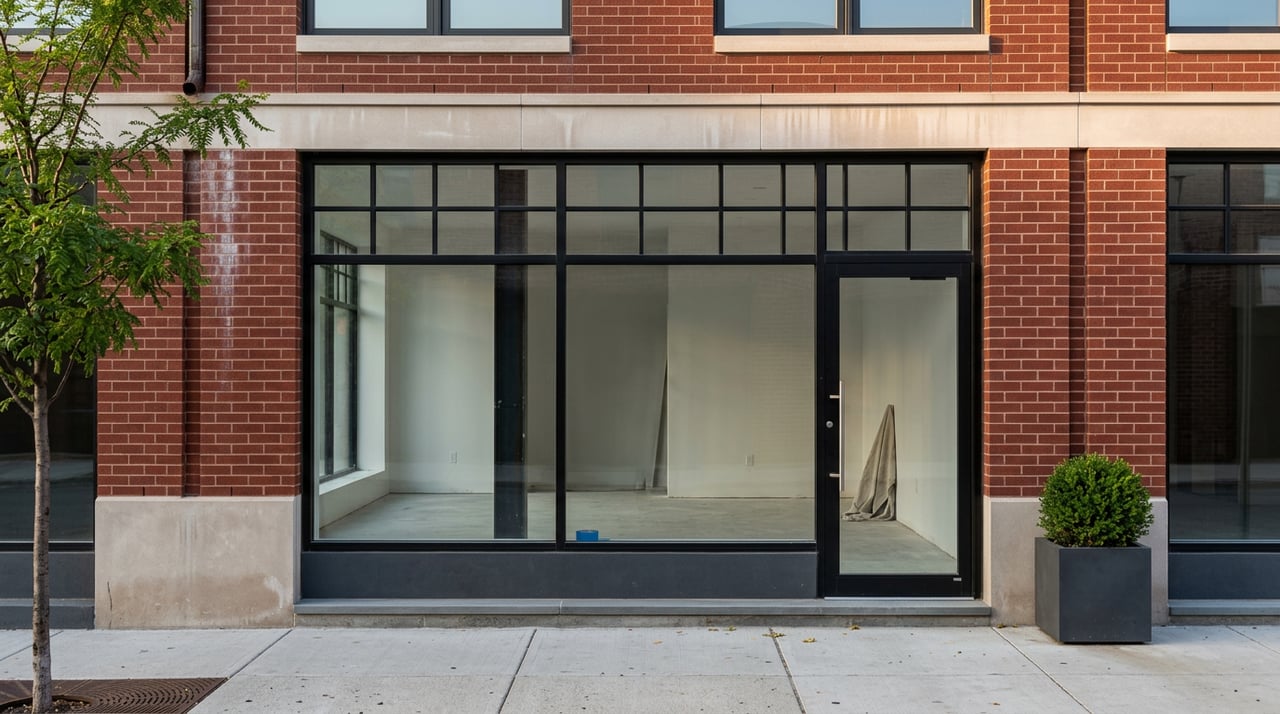
333 North Broad is Doylestown Borough's largest ever mixed-use redevelopment: a $77 million Cornerstone Tracy project on the former Doylestown Intelligencer site, designed by Bernardon and managed by Bozzuto, delivering 235 apartments across four linked buildings on 7.6 acres, plus roughly 400 parking spaces and 10,000 square feet of ground-floor retail. Borough manager John Davis described it as the last piece of a thirty-plus-year plan to convert the borough's old industrial back door into a walkable gateway.
Residential leasing began in late 2024. The first two retail tenants were not announced until May 2026:
- Degree Wellness, a national wellness and recovery franchise
- Dollop Frozen Yogurt, a family-owned concept from Doylestown native Lauren Fitzmartin
That fills two of four ground-floor storefronts. The developer had publicly told Patch a year earlier that conversations were open with restaurants, coffee shops, retail, and spa uses. What actually signed is narrower: wellness and a specialty dessert operator. Neither is a comparison-shopping retailer. Neither is a full-service restaurant. Both trade heavily on the on-site residential base rather than pedestrian catchment from Main and State.
The signal is not that Broad Street is soft. The signal is that new-build mixed-use pads in the borough behave more like an apartment amenity floor than a Main Street storefront during first lease-up, and operators price that in.
Three Micro-Corridors, Three Rent Realities
For a borough that fits inside three square miles, Doylestown supports at least three distinct retail submarkets, and the posted asking rents flatten a very real gap in demand velocity.
| Micro-corridor | Representative asking rent | What is actually signing |
|---|---|---|
| State / Main core | ~$22–$23/SF on West State (e.g., 180 W. State, 2,000 SF at $23.00/SF) | Independent F&B and boutique retail; recent openings include Facenda Spirits at 24 N. Main and Exclusively Men's Barber & Spa at 2 E. Court |
| North Broad gateway | Contact for pricing at 333 N. Broad; comparable new-construction Class A range in-market | Wellness/recovery franchise, boutique dessert |
| Adjacent Buckingham centers | ~$25/SF at Buckingham Green 2 (4920 York Rd) and Cold Spring Center (5175 Cold Spring Creamery Rd) | Suburban service retail with parking-first layouts |
The dollar difference between $23 and $25 per foot is not the story. The story is that the State/Main core is signing operators who can convert walk-by traffic into revenue on day one, the Broad Street gateway is signing operators who can afford a slower ramp because their model tolerates a captive residential base, and the Buckingham suburban centers are signing operators for whom parking geometry matters more than sidewalk width. A tenant using a single blended rent to compare these three is buying the wrong asset.
One posted number worth flagging so a reader does not misread it: a 144-square-foot micro-suite at 10 S. Clinton was posted around $70.83/SF. That is a shared-office fractional suite, not a storefront comp, and it should be excluded from any retail underwriting.
The Supply Wave Landlords Are Underestimating
The second block of new supply is the corner of West State and North Franklin. Worth & Worth LLC demolished the former Striker Soccer at 161 W. State and the adjacent Repco Auto Parts, and Borough Council approved preliminary/final plans for approximately 6,000 square feet of new retail and office space with rear parking accessed from North Franklin through an alleyway. Owner Ann Worth has publicly said she is targeting long-term tenants, retail boutiques, and possibly a medical or professional office.
Stack that against 333 North Broad's remaining two storefronts, and the borough is absorbing on the order of 12,000 square feet of new-construction retail supply plus 6,000 square feet of ground-up replacement supply inside roughly eighteen months. That is meaningful in a three-square-mile borough where posted retail comps are typically 1,400 to 4,500 square feet.
For a landlord holding an older State Street storefront, the leverage math has shifted quietly:
- A prospective tenant now has two credible new-construction alternatives within a five-minute walk.
- Free-rent periods and tenant-improvement contributions on new construction reset expectations.
- Use exclusivity is worth asking for. It was not, twelve months ago.
For a tenant, the same shift reads as the first legitimate negotiating window since 2019.
Why the Core Still Prices Like the Core
None of the above means the historic core has softened. Two data points on public investment cut the other way.
The Borough is executing the first major repaving of East and West State Streets since the 1990s, fully state funded. Separately, a $550K-plus state-grant project is upgrading the intersection of West State, West Court, and Clinton Streets in late summer and early fall. Public investment on that scale, coming through in the same eighteen months as the private supply wave, tells a landlord on the core that the underlying pedestrian pattern is not being abandoned. It also tells a tenant that short-term construction friction is real and worth negotiating around in a start-date clause.
Layer in the June 19, 2026 opening of The Roof on Main at 22 South Main, the 2,700-square-foot rooftop bar atop Main Street Sport & Social. The venue seats roughly 200 to 250, features a 28-seat climate-controlled bar and two private cabanas, pours Pennsylvania-only beer, wine, and spirits, and partners with Villa Capri and The Side Bar for food. Owner Will Wister, a Doylestown native and Central Bucks West graduate, has now stacked golf simulators, duckpin bowling, mini-golf, a third-floor bar, and a rooftop into a single Main Street address. That kind of concentration deepens the reason to be on Main rather than adjacent to it, and it is the clearest argument for why State/Main asking rents are unlikely to compress even as new supply lands two blocks north.
What This Means If You Are Signing in the Next 18 Months
If you are the tenant
Underwrite the corridor, not the borough. A wellness operator that pencils at $28 all-in on Broad Street may not pencil at $23 base plus NNN on West State once you model the difference between residential foot traffic and destination foot traffic. Ask specifically:
- What is the co-tenancy mix on the day you open, not the day you sign?
- Who controls the sidewalk experience during State Street repaving and the West State/Clinton intersection work?
- On new construction, what is the delivery condition and what portion of build-out is landlord-funded? At Doylestown rents, TI is where the deal is actually made.
If you are the landlord
The tenants signing right now are wellness and recovery, boutique F&B, small-format specialty retail, and professional services including medical. Comparison-shopping apparel and traditional soft-goods retail are underrepresented in the last twelve months of openings. If your building is priced for a use case that is not signing, you are competing for a smaller pool than the asking-rent sheet suggests. A repositioning conversation, including layout, HVAC capacity for food or wellness build-outs, and rear-access parking, is often more valuable right now than a rent adjustment.
FAQ
Is Doylestown Borough overbuilt on retail? No. The absorption timeline at 333 North Broad reflects the lease-up curve of new mixed-use ground floors, not oversupply. Two of four storefronts signed inside twelve months in a market that historically turns core space in weeks is a slow ramp, not a broken one.
Are asking rents on State Street likely to move? Public investment in State Street and the West State/West Court/Clinton intersection, combined with the deepening entertainment cluster at Main Street Marketplace, supports current pricing on the core. Concessions, not headline rent, are the more likely lever over the next two lease cycles.
Is 333 North Broad a Main Street competitor or an amenity? Functionally, based on what has signed, it is closer to an amenity floor for a large residential base than a Main Street extension. That may change as the remaining two storefronts fill, but underwriting it as a substitute for a State/Main location today would overstate its walk-by economics.
If you are a landlord, tenant, or owner-user weighing a Doylestown Borough decision in this cycle, the corridor you choose will drive the deal terms more than the headline rent will. Commercial Partners SERHANT works block-by-block across the borough and the surrounding Central Bucks corridors. Contact us to pressure-test your site, your pro forma, or your repositioning plan before you sign.