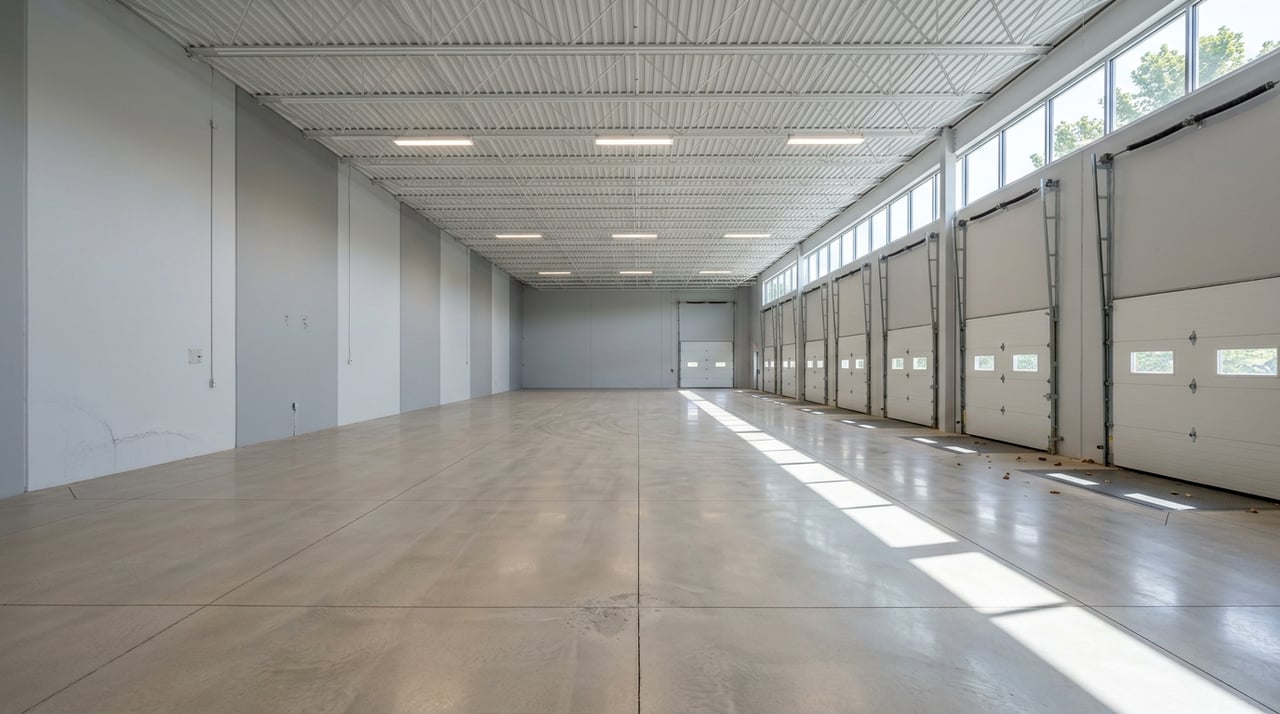
A tenant walked into our office in June looking for something specific: 90,000 to 110,000 square feet of Class A warehouse, 30-plus foot clear, dock-loaded, inside Philadelphia city limits, close to I-95. Their broker in another market had run the numbers and told them Philadelphia County industrial vacancy was pushing 12%, so options should be plentiful. In practice, there was one building under construction that fit the brief, and it had not yet been leased.
That gap between what the headline vacancy number implies and what a mid-size user can actually tour in Northeast Philly is the whole story. If you are evaluating a Northeast Philadelphia site against a Bucks County or South Jersey alternative in 2026, the county-wide vacancy figure is the least useful number in your comparison.
The Number That Misleads
The vacancy rate in Philadelphia declined from 12.2% to 11.9% during the quarter, according to Colliers' Q2 2026 report. Read that as "market is soft" and you will misprice your negotiation.
Now layer in what is actually being built. The only speculative project currently under construction is Crow Holdings' 103,552-square-foot building at 2748 Grant Avenue. Everything else in the pipeline is committed. Construction activity remains led by major build-to-suit developments. DrinkPak's 1.4 million-square-foot facility at the Bellwether District is progressing steadily, and that space is spoken for.
At the regional level, the construction pipeline has contracted sharply from its 2023 peak to roughly 600,000 SF, or about 1.0% of inventory, by the first quarter of 2026. Meanwhile new leasing increased 16.4% YOY to 3.4 million square feet across the Philadelphia industrial region in Q1 2026. Demand accelerating, speculative supply contracting, headline vacancy elevated. Those three facts sit in the same market because vacancy is concentrated in older, previous-generation product, not in the kind of building a modern distribution or e-commerce tenant will sign for.
What Is Actually Leasing Along the Boulevard and I-95
Recent activity in and near the Northeast tells a cleaner story than the vacancy figure:
| Property | Size | User | Deal Type |
|---|---|---|---|
| 2748 Grant Avenue | 103,552 SF | TBD (spec) | Under construction, Class A |
| 14515 McNulty Road | 147,000 SF | Martin Brower | Full-building lease |
| Byberry East facility | 100,000 SF | Rush Order Tees | Owner-user acquisition |
| 2900 Grant Avenue | 112,000 SF | Amazon | Existing lease |
| 15000 Roosevelt Boulevard | 656,904 SF (two buildings) | Available | Rockefeller Group / PCCP development |
Martin Brower signed a full-building lease for the 147,000-square-foot McNulty Road facility; its "spec to suit" construction will be completed this fall. Rush Order Tees' acquisition of a 100,000-square-foot facility in Byberry East pulled another 100,000 feet of mid-size inventory off the market. Rockefeller Group and PCCP are developing Rockefeller Group Logistics Center on the Boulevard on 50.44-acres. The project includes two logistics buildings, 318,696 square feet and 338,208 square feet, for a total of 656,904 square feet.
Every one of those transactions clusters within a few miles of the I-95 / Roosevelt Boulevard intersection with Grant Avenue and Byberry Road. That is not coincidence. It is the same infill logic that Northern New Jersey and the Meadowlands have priced in for years, showing up in the last major infill submarket on the I-95 corridor that has not fully repriced.
Why the Mid-Size Class A Gap Exists
Crow Holdings has been explicit about the thesis. The company believes that in urban areas like Philadelphia, smaller-footprint buildings, around 250,000 square feet or less, are the most effective without the high costs associated with larger, million-square-foot developments typically found farther from the city center. That is a developer telling you their underwriting rewards the sub-250,000 SF box in Philadelphia, not the mega-box.
The 2748 Grant Avenue spec sheet gives you the modern benchmark to compare any Northeast Philly existing building against: 32-foot ceiling heights, 32 dock positions, two drive-in doors and parking for 65 vehicles. The property benefits from the City of Philadelphia's 10-year tax abatement program.
If you tour a 1980s or 1990s Northeast Philly warehouse with 22-foot clear and eight docks, the asking rent may look attractive against the newer product. Run the math on cube utilization, and the effective cost per pallet position often flips the decision. That is the mechanism behind the split market. Aggregate vacancy stays elevated because older, previous-generation buildings are slow to lease, while the modern mid-size Class A shelf is effectively empty.
Corridor Investment Is Changing the Denominator
The physical corridor around these buildings is being rebuilt in parallel. Engineering continues on a 12-mile traffic safety and transit improvement project on Roosevelt Boulevard. It is set to run from Broad Street to Old Lincoln Highway in Bensalem, Bucks County. The $78 million project is federally funded with state speed camera grant support. The Route for Change program will include three major phases: The Boulevard Today – projects to be completed by 2027, The Boulevard Tomorrow – traffic safety and transit improvements to be completed by 2031, The Boulevard Reimagined – road design and transit services that will change the look and feel of the Boulevard after 2040.
The near-term construction that matters for logistics access: this winter, PennDOT will begin work to improve crossovers at five locations between Cottman Avenue and Red Lion Road. Those crossovers sit directly between the industrial parks north of Grant Avenue and the commercial spine of the neighborhood. For an operator running the same truck route ten times a day, a redesigned crossover changes the schedule math.
Retail is moving in the same direction. The 60-year-old Northeast Philly shopping center is undergoing a more than $70 million makeover that promises to bring it into the modern age with new tenants, upgraded facades, and a better layout. As Brixmor executives walked around the 620,000-square-foot complex on a recent day, they said they already see the outdoor mall becoming a community hub, with a gym, an organic grocer, and new fast-casual dining options. About 70% of Roosevelt Mall's customer base lives within a 3-mile radius of the shopping center. That is a tight, captive trade area getting a re-tenanted anchor with Oak Street Health, LA Fitness, and a forthcoming Victoria's Secret pulling foot traffic through 2026 and 2027.
For a retail tenant hunting a Northeast Philly outparcel or inline space, Roosevelt Mall's re-merchandising is repricing adjacent rents. For an industrial tenant, the same investment signals that the corridor is getting institutional attention on both sides of the demand equation.
How to Read This Depending on What You Are Doing
If you are a tenant looking for 50,000 to 150,000 square feet. The spec inventory does not exist yet. 2748 Grant Avenue delivers mid-2026 and will lease to one or two users. After that, the next available Class A mid-box in the city is a build-to-suit, which puts you on a 12 to 18 month clock. If your lease expiration is inside that window, the negotiation is not about rent, it is about extension terms on your current space so you can wait for the right building without a hostage premium.
If you are an owner-user weighing lease versus buy. Rush Order Tees' acquisition of an existing 100,000 SF facility in Byberry East is the template. Class A new construction at 2748 Grant benefits from a 10-year tax abatement, but the total occupancy cost still runs meaningfully above a repositioned existing building. If you can absorb a 22 to 28 foot clear and retrofit dock counts, the existing-building path is where the value is right now. If your operation genuinely needs 32-foot clear and 32 docks, the tax abatement offsets a portion of the new-construction premium and the math tightens.
If you are a landlord holding a previous-generation Northeast Philly building. The 11.9% aggregate vacancy is a warning about your comp set, not the market. Tenants that would have taken your building in 2019 are now signing at newer product a mile away. The move is either a targeted repositioning that adds clear height and modern dock equipment, or a use conversion where a specific tenant type such as last-mile courier, self-storage conversion, or light manufacturing values the location more than the ceiling. Holding and waiting for the tide to lift the price is the option with the weakest odds.
FAQ
How does Northeast Philly industrial pricing compare to Bucks County? Bucks County's industrial vacancy has moved the other direction. Vacancy declines in Chester and Montgomery counties were insufficient to offset increases in Bucks and Delaware counties, resulting in a rise in the overall suburban vacancy rate from 7.5% to 7.7%. Elevated vacancy among previous-generation industrial properties in the 40,000- to 100,000-square-foot range is the same story that plays out in Northeast Philly. Bucks gives you more existing inventory to choose from at the small-to-mid end. Northeast Philly gives you closer proximity to city population and the port. The submarkets are not substitutes, they are different tools.
Is the 10-year tax abatement at 2748 Grant Avenue available elsewhere in the Northeast? The abatement is a citywide program on new construction and improvements, not a Grant Avenue special. Its value depends on the assessed improvement, so a $25 million new-build like 2748 Grant captures materially more benefit than a $2 million tenant improvement to an existing shell. Confirm the specific application to any building you are evaluating.
Should a growing regional tenant wait for the next spec building? For most tenants, no. The next spec cycle depends on where interest rates and construction lending land in late 2026 and 2027. A build-to-suit conversation, structured against your actual operational spec, moves faster than waiting for someone else's speculative building to hit the market and match your requirements.
The businesses moving first in Northeast Philadelphia right now are the ones treating the county-wide vacancy figure as noise and the mid-size Class A gap as the signal. If you are running that math for your own occupancy, expansion, or disposition, Commercial Partners SERHANT works these Boulevard and I-95 corridor deals from the tenant, owner-user, and landlord side. Contact us for a direct read on how the Northeast fits your next move.